Velocity Meter 12.22
Weekly news and intelligence on how AI is reshaping business. Curated by the partners at Velocity Road.

📊 The Boring AI Wins: Why Unsexy Workflows Beat Transformation Theater
Mid-market leaders keep chasing AI moonshots while the real returns pile up in places nobody photographs for LinkedIn. Insurance claims handlers are processing documents 50% faster. Retailers are embedding AI into photo workflows without press releases. Professional services firms are automating compliance checks that save hours daily.
The pattern is clear: companies capturing genuine value aren't announcing "AI transformation strategies." They're quietly embedding intelligence into existing workflows until those improvements become impossible to remove.
Let's dive in.

⚡️ Zara Doesn't Do AI Transformation. It Just Ships Faster.

The fashion retailer's AI implementation reveals something most executives miss: the technology works best when nobody notices it arrived.
Zara uses generative AI to create product imagery variations. Not revolutionary. Not disruptive. Just faster content production embedded in existing pipelines. Each garment needs multiple visual variations for different regions and channels. AI compresses those cycles by reusing approved material and generating variations without resetting the entire process.
The placement matters as much as the capability. Zara isn't positioning AI as a separate creative product or asking teams to adopt entirely new workflows. The tools sit inside existing production pipelines, supporting the same outputs with fewer handoffs.
No published cost savings figures. No claims about transforming the creative function. No grand strategic announcements. Just small, practical changes that make everyday work move slightly faster—until those changes become hard to imagine doing without.
Bottom Line: The most durable AI adoption happens through workflow embedding, not transformation announcements.

🏭 AI Across Industries

🏥 Insurance Operations: The Unsexy Advantage
Major insurers are moving AI from pilots to production by focusing on operational control rather than innovation theater.
Allianz's Insurance Copilot helps claims handlers automate repetitive tasks and pull together information that previously required multiple system searches. The workflow changes are specific: data gathering, document analysis, discrepancy flagging, context-aware email drafting. Claims handlers make decisions; AI does the reading and drafting.
Zurich applies generative AI to commercial insurance complexity across multiple jurisdictions. The tool processes unstructured information, builds quicker pictures of multinational offerings, and simplifies submissions across countries. Contract certainty improves because AI helps internal experts compare, summarize, and verify coverage "in a fraction of the time" compared with manual translation efforts.
Aviva launched AI-powered summarization for GP medical reports that can span dozens of pages. Underwriters make faster decisions because technology reduces reading time, not because AI replaces underwriting judgment.
📌 Takeaway: Operational gains compound when AI assists high-frequency tasks rather than replacing strategic roles.
💼 Professional Services: Quality at Lower Cost
CohnReznick demonstrates how professional services firms simultaneously embed quality improvements while reducing costs.
Partner Asael Meir frames it clearly: AI enables the firm to use technology for research, content creation, and quality control—cheaper and faster than traditional methods. The compliance function illustrates this. AI completes repetitive tasks like formatting and proofing at reduced cost while delivering real-time risk management rather than periodic reviews.
The shift changes client expectations. Clients now expect value from AI innovation whether in audit or tax. The systems and tools must improve to meet that expectation.
📌 Takeaway: AI's operational value emerges when it improves output quality while reducing delivery cost.
🏭 Manufacturing: The J-Curve Nobody Mentions
MIT research on manufacturing firms reveals an uncomfortable truth: AI introduction frequently leads to measurable but temporary performance declines before stronger growth emerges.
This J-curve trajectory helps explain why economic impact underwhelms despite transformative potential. AI isn't plug-and-play. It requires systemic change, and that process introduces friction. Firms that were already digitally mature before adopting AI see the strongest gains. Past data predicts future outcomes more reliably. Size helps too—solving adjustment costs and scaling benefits across more output accelerates the upswing.
The research found better integration and strategic resource reallocation drives recovery as firms gradually shift toward AI-compatible operations, often investing in automation technologies like industrial robots.
📌 Takeaway: Mid-market firms must prepare for temporary productivity dips when implementing AI at scale.
🏦 Financial Services: Automation Without Drama
Financial institutions are capturing value through operational improvements rather than customer-facing innovation.
The benefits concentrate in predictable areas: reduced manual data entry speeds up processes while minimizing human error. Lower operational costs emerge as automation handles tasks like loan processing and compliance checks that previously required large teams. Enhanced accuracy follows when automated tools adhere to precise workflows, reducing error risks and costly corrections.
AI and machine learning enable institutions to analyze vast information amounts, identify patterns, and make data-driven decisions in real time. Robotic process automation handles rule-based operational tasks including report generation, account reconciliation, and fraud detection with reduced manual intervention and decreased errors.
📌 Takeaway: Financial services gains accumulate through back-office efficiency, not front-office flash.

📈 AI by the Numbers

📉 40% productivity gains missed
Organizations miss 40% of AI productivity gains due to gaps in talent strategy. Companies using AI effectively with adequately trained talent achieve 40% higher productivity gains than those without proper training foundations.
⚡ 55% talent exodus risk
Employees receiving over 81 hours of annual AI training report 14 hours per week of productivity gain—nearly double the median. However, these same employees are 55% more likely to leave due to external opportunities outnumbering internal promotion cycles.
🏢 4.2% vs 44% adoption divide
Singapore's AI adoption reveals structural gaps: only 4.2% of SMEs adopted AI in 2023 compared to 44% of large enterprises. Cost, skills gaps, and knowledge barriers prevent smaller companies from capturing AI benefits.
📊 20% faster document processing
AI-powered document automation in financial services reduces loan fulfillment times by 20% while achieving 97% extraction accuracy and reviewing documents 50% faster than manual processes..
💰 $16M median AI investment
Organizations in Singapore report median planned AI spending of $16 million, higher than the global median of $12.5 million, demonstrating enterprise commitment to scaling AI capabilities despite implementation challenges.

📰 Five Headlines You Need to Know
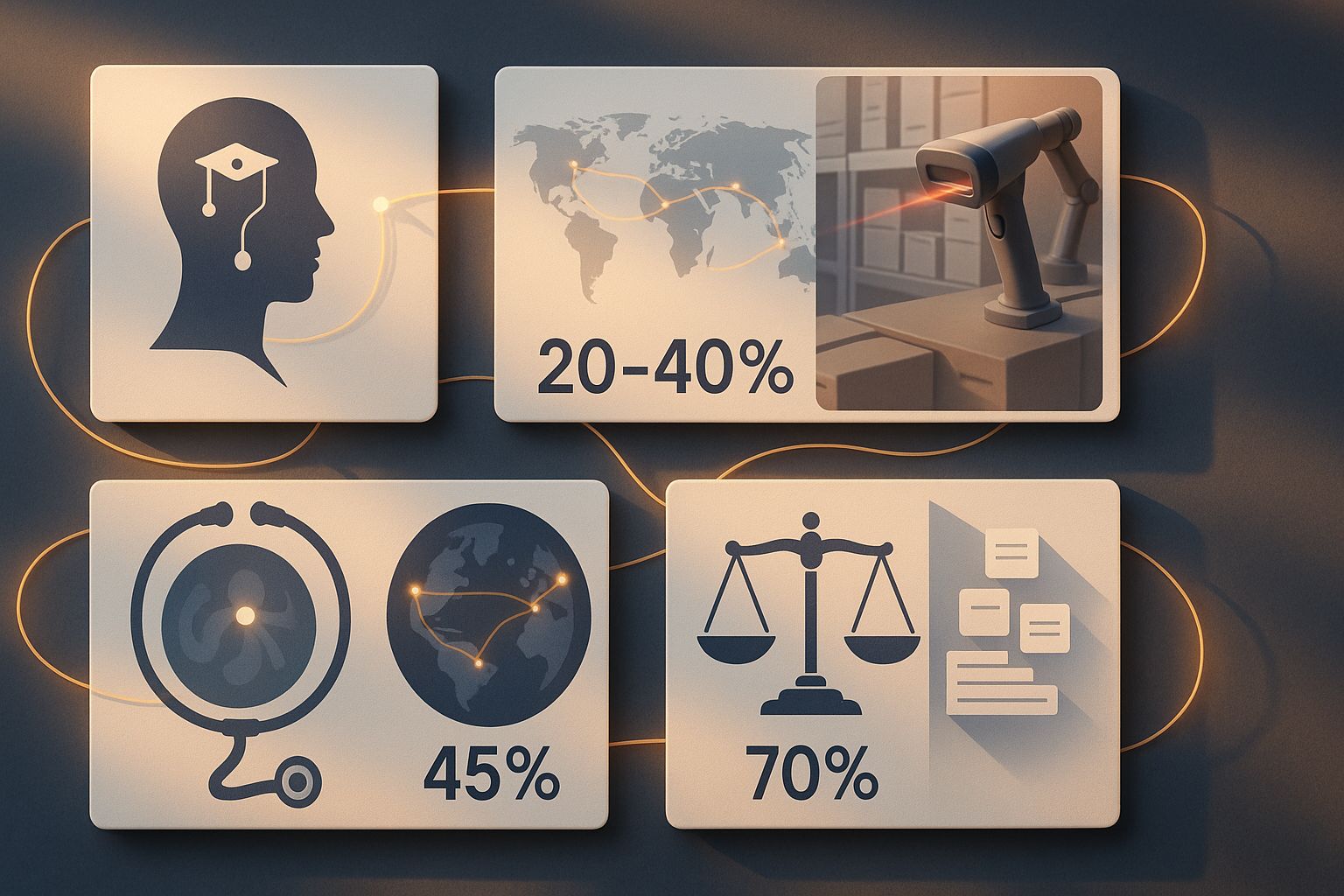
🏭 AI workforce upskilling drives competitive advantage
Organizations implementing AI-powered learning ecosystems are transforming workforce development through personalized training paths, real-time skill assessments, and adaptive content delivery that accelerates employee capability building.
🛍️ Retail automation cuts costs 20-40%
Retailers implementing AI-driven automation improve efficiency by up to 40%, with automated inventory systems reducing out-of-stock incidents by 25% and customer service costs dropping 30% through AI chatbots.
🏥 Medical AI reduces diagnostic errors 45%
Hospitals implementing AI-powered diagnostic support and clinical documentation see 45% fewer diagnostic errors while saving over $1 million annually through improved efficiency.
⚖️ Legal AI slashes case prep time 70%
Law firms deploying agents that scan case databases and extract relevant precedents reduce case preparation time by 70% while catching details human reviewers might miss.
📈 Supply chain disruption drives new models
The era of stable supply chains has ended, forcing companies to build AI-driven operating models that adapt to continuous volatility rather than optimizing for predictability.

🎯 The Final Take: The Operational Reality

The companies capturing AI value aren't the ones making transformation announcements. They're embedding intelligence into workflows where small improvements compound over thousands of daily interactions.
Insurance claims handlers process documents faster. Retailers generate product variations without production resets. Professional services firms automate compliance checks. Financial institutions reconcile accounts with higher accuracy.
These aren't moonshots. They're operational improvements that deliver measurable returns because they focus on high-frequency, knowledge-intensive tasks where efficiency gains multiply across volume.
The pattern holds: durable AI adoption happens when technology supports existing work rather than replacing it, when gains accumulate through workflow embedding rather than strategic repositioning, and when success measures operational improvement rather than innovation theater.
For mid-market leaders, the playbook is clear. Skip the transformation announcements. Identify high-volume workflows where small gains compound. Embed AI as an operational assistant, not a strategic replacement. Measure improvement in cycle time, accuracy, and throughput—not in vision statements.
The boring work delivers the returns.
Until next week!
🎯 At Velocity Road, we help mid-market companies identify operational workflows where AI delivers measurable returns. We build implementation roadmaps that embed intelligence into existing processes rather than forcing transformation theater. Let's discuss how boring operational wins create competitive advantage:
📬 Forward this newsletter to colleagues who need to understand AI's production reality. And if you're not subscribed yet, join thousands of executives getting weekly intelligence on AI's business impact.